Sergey Bezrukov
in Socionics and MBTI
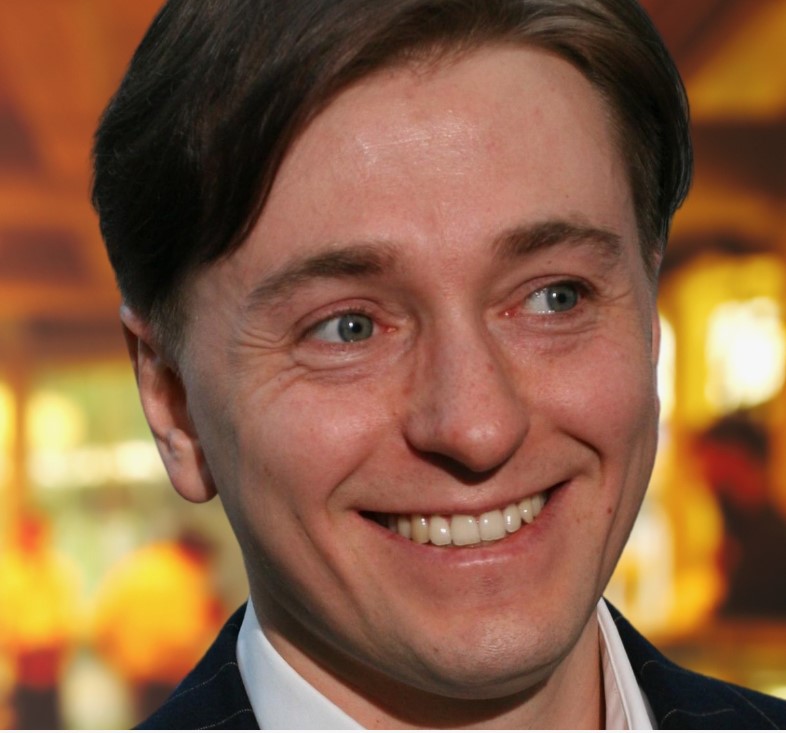
Sergey Bezrukov
Intuitive Ethical Extravert
Socionics Type: Huxley (Advisor)
MBTI Personality Type: ENFP (Campaigner)
Base (worldview): Intuition of Possibilities
Creative (also strong): Ethics of Relations
Painful (most vulnerable): Structural Logic
Suggestive (expected from others): Sensing of Sensations
Temperament: Flexible-Dynamic (~Sanguine)
Communication Style: Passionate
Quadra: Delta (values: ideas and possibilities, bodily sensations, personal relationships, practice and application)

Same Personality Type

Representatives of sociotype Huxley in socionics Representatives of sociotype Huxley in socionics Representatives of sociotype Huxley in socionics

Ivan Urgant, Mikhail Boyarsky, Olga Buzova, Andrey Malakhov, Volodymyr Zelenskyy, Maksim Golopolosov, Yury Stoyanov, Nikolay Baskov, Dima Bilan, Yuliya Menshova, Vlad Kadoni, Dmitry Dibrov, Grigory Leps, Klava Koka, Ilya Sobolev, Tais Logvinenko (tAISh), Yury Shevchuk, Prokhor Chaliapin, Vadim Demchog, Mikhail Gorshenev (Korol i Shut), Alan Badoev, Marat Basharov, Sergey Bezrukov, Leonid Yarmolnik

Sociotypes of 321 Celebrities

As of today, personality types in Socionics and MBTI have been identified for 321 famous people. The full list is available here, and you can also use the search:

Intuition of Possibilities

The deep essence of phenomena, their hidden or implicit aspects, “looking around the corner,” multivariant thinking, synthetic thinking (seeing the whole through implicitly connected parts), seeing possibilities, variety, alternatives, originality, uniqueness, interest, novelty, inventions, ideas, insights, paradoxes, seeing the essence of a person, their abilities, potential, hidden sides of a person, etc.

Ethics of Relations

Relationships between people and managing them, family ties, friendships, morality, ethics, friendship, likes and dislikes, attraction and repulsion, love and hate, morality and immorality, compassion and heartlessness, decency, humanity, tactfulness, warmth, personal boundaries, conscience, upbringing, actions, attitude toward something, desires, empathy as understanding attitudes, etc.

Structural Logic

Systems and their internal connections, analytical thinking (breaking things down to understand their internal links and structure), theory, studying theory, distinguishing what is primary from what is secondary, structure, analysis, cause-and-effect relationships, rules, laws, hierarchies, subordination, classifications, lists, tables, diagrams, formulas, terms and their definitions, programming, etc.

Sensing of Sensations

Sensations from the nerve endings (smell, taste, sight, touch, etc.), the vital functioning of one’s own and other organisms, health, well-being, pain, bodily pleasures (food, drinks, relaxation, etc.), treatment, rest, aesthetics, beauty, harmony of colors and forms, comfort and convenience, weather, etc.

Pragmatic Logic

Order and correctness of actions, application, practice, mastery and professionalism, work, abilities and skills, technologies, production, materials, tools, methods, facts, efficiency, usefulness, quality, use of objects, useful properties of objects, mechanisms and devices, interaction of mechanisms, money (from the standpoint of related actions), competitiveness, sales and purchases, income and expenses, prices, profit, etc.